Key Takeaways
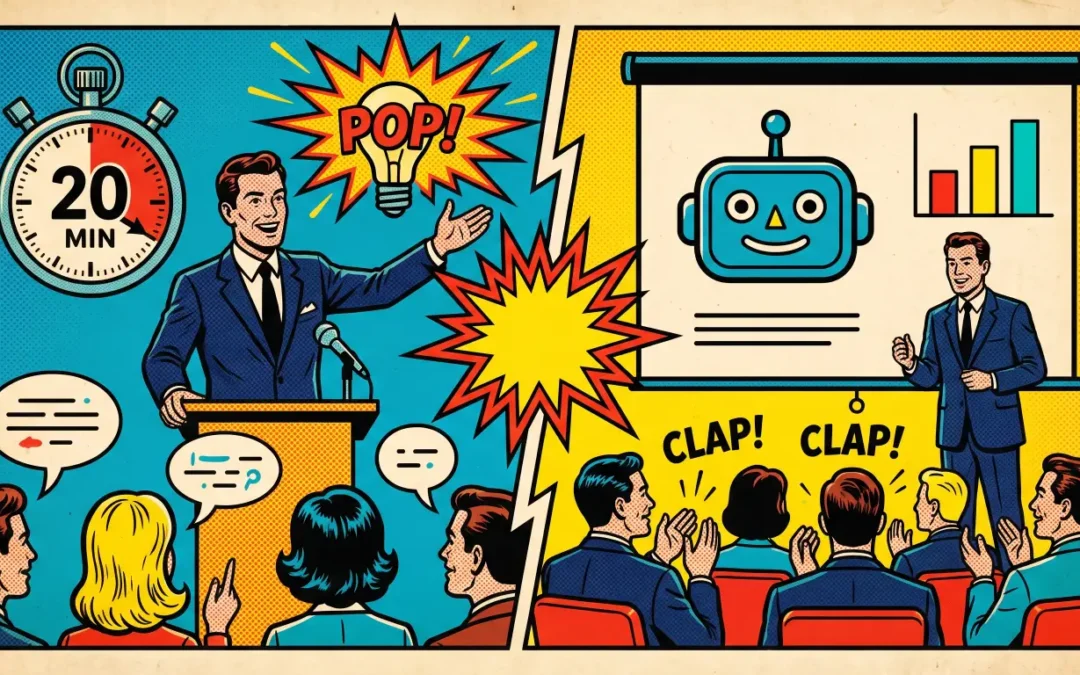
- An AI impulse talk runs from 20 minutes and plants one thought – a keynote takes 45 to 90 minutes for the full line of argument.
- The impulse fits when the programme is packed, the topic is new, or AI is one building block among several.
- The keynote fits when AI is the leading theme of the event and attitudes are meant to shift.
- What decides the outcome is not the length but the follow-up: what happens in the two weeks after the stage?
“We only have 20 minutes in the programme – is that even enough for AI?” I hear this in briefing calls all the time. The short answer: yes, if you know what an impulse can do – and what it cannot. The long answer follows here.
What Really Separates an Impulse Talk from a Keynote?
The difference is not the clock, it is the assignment. An impulse talk sets one thought that sticks and opens the door for whatever comes next in the programme. A keynote builds a chain of reasoning: situation, consequence, options for action – with room for live demos, examples and objections from the audience.
- Impulse talk from 20 minutes: one core message, two or three examples, one clear call to action.
- Keynote of 45 to 90 minutes: a full narrative arc, several live demos, question round.
- Workshop, half or full day: the participants do the work, not just the speaker.
When Is the AI Impulse Talk the Better Choice?
In four situations the short slot beats the long one – not as a budget version, but as the more suitable format.
- Packed programme: when annual figures, awards and strategy are already scheduled, an impulse lands better than a talk that bursts the agenda.
- AI as one topic among several: for instance at a leadership meeting covering four priorities.
- Morning opener: the impulse gives the day a shared language before the working groups start.
- Evening event: nobody listens for 60 minutes after dinner – but 20 pointed minutes work.
When Should You Book the Full Keynote?
As soon as not only knowledge but attitude is supposed to change. Anyone who wants to reduce scepticism, clarify roles and anchor concrete next steps needs time for live demos and for the questions that only surface after twenty minutes. A mixed audience – from the board to back-office staff – also argues for the longer form, because different levels of prior knowledge have to be picked up. Rule of thumb: the greater the expected resistance, the less an impulse will do.
How Do You Get the Most out of 20 Minutes?
A good impulse is not a shortened keynote. It is built differently – and preparation matters more here than in any other format.
- Settle on one core message, not five. What should people quote during the coffee break?
- One live example instead of three slide quotes – ideally from the audience's own working day.
- Briefing up front: industry, prior knowledge, internal points of contention. Without it, every impulse turns generic.
- Plan the follow-up: one question for the table discussions, a follow-up date, a named owner.
- Test the technology – in a 20-minute slot, every minute of delay costs five percent of the impact.
How Does a 20-Minute AI Impulse Talk Unfold?
Twenty minutes sound short, but they can be planned well. A sequence in four beats has proven itself. It lands harder than a slide marathon on fast-forward:
- Minutes 0 to 3 – open with a question from the audience's own working day: where does routine work cost the most time today?
- Minutes 3 to 12 – one live example: an AI application solves a real task in front of everyone, such as summarising a meeting or drafting a customer letter.
- Minutes 12 to 17 – transfer: what does this mean for your roles, your processes and your rules for handling data?
- Minutes 17 to 20 – a clear call to action: one first step that everyone can try out themselves next week.
The live part is the heart of it. A result created in the room convinces more than any statistic. And it delivers exactly the material the coffee break needs. Simply cutting a 60-minute keynote down to 20 minutes, on the other hand, usually loses the example – and with it the impact.
Which AI Topics Work as an Impulse at a Conference?
Not every topic fits into twenty minutes. Questions that affect the audience directly and can be made tangible with one example work well:
- Leading with AI: what changes for managers when teams work with AI assistants – in delegation, quality control and trust?
- AI in everyday work: how Copilot in Microsoft 365 speeds up emails, minutes and reports – and where its limits are.
- AI agents: what happens when software no longer just answers but completes tasks on its own?
- Customers and sales: how AI changes advice and service without replacing personal contact.
For topics that need a lot of explanation – a company-wide AI strategy, say, or rules on data protection and the EU AI Act – the keynote is usually the better format. How to recognise quality regardless of length is covered in what makes a great AI keynote.
What Does an AI Impulse Talk Cost?
The fee does not follow speaking time but preparation, travel and coordination – the minutes on stage are the smallest part of the work. My AI keynote page states it transparently: 6,900 euros plus VAT per keynote and a 500 euro flat travel fee, with workshops quoted individually. For impulse formats inside a convention we agree the scope in the briefing call.
Planning an event? As a keynote speaker for artificial intelligence, digitalization and Microsoft 365, I bring technology topics to the stage in a way that sticks – hands-on, entertaining and immediately actionable. Book an AI keynote: content, formats and fee at a glance.
Frequently Asked Questions (FAQ)
How Short Can an AI Impulse Talk Be?
From roughly 20 minutes the format works. Below that there is time for a message but no longer for a convincing example – and it is the examples that people remember.
Can an Impulse Talk Be Delivered Online?
Yes, online and hybrid both work. For digital formats I cut the impulse even tighter: shorter blocks, more interaction, a visible screen instead of a lectern.
How Much Lead Time Do You Need?
Three to six months are comfortable, shorter notice often works too. What matters less is the lead time than the briefing call about four weeks before the event.
Can an Impulse Talk and a Workshop Be Combined?
That is in fact the most effective option: the impulse for everyone in the morning, the deep dive in the afternoon with the group that has to implement afterwards. Breadth meets depth.
Is an Impulse Talk the Same as a Short Keynote?
In everyday event planning the terms overlap: a short talk of usually 20 to 30 minutes that sparks a topic rather than covering it completely. In German-speaking events it is called an Impulsvortrag or Impulsreferat. What matters is the assignment, not the label.
Does an AI Impulse Work for a Leadership Conference?
Yes, especially there. Managers do not need a technology course but a clear picture of what AI means for roles, decisions and teamwork. An impulse at the start of the conference creates that shared basis. The working groups then go deeper into the questions that concern their own organisation.
What Should Happen After an AI Impulse Talk?
An impulse only works if something happens afterwards. Three building blocks have proven themselves: a guiding question for the table discussions right after the talk, a short summary to read up on in the intranet, and a fixed date about two weeks later. There, a named owner reports what was tried out and what did not work. That turns twenty minutes on stage into a real starting point for your organisation.
Is the Impulse Available in English?
Yes, in German and English. With an international audience we clarify in advance which examples carry in which market – otherwise you translate words but not impact.