Key Takeaways
- A great AI keynote translates technology into business value – it does not show what AI is, but what it does for your company.
- Live demos beat slides: when the audience sees a result appear in seconds, skepticism tips over into curiosity.
- Concrete use cases from the daily work of the audience make the difference between entertainment and implementation.
- Good speakers take fears seriously instead of ridiculing them – and send every listener home with a first doable step.
- The format follows the goal: an impulse talk to open minds, a keynote to shift attitudes, a workshop to build skills.
- What matters for event planners: the speaker's hands-on experience, interaction, and a talk tailored to the industry.
After several hundred keynotes on artificial intelligence, I can say one thing with certainty: audiences do not remember architecture diagrams. They remember the moment something is created live on stage that would have taken three hours of work yesterday.
Why Is Expertise Alone Not Enough for an AI Keynote?
Many AI talks fail not because of their content but because of their altitude. Speakers who only talk about models, parameters and trends lose decision-makers after ten minutes. The art lies in translation: What does generative AI mean for the sales director, the head of HR, the managing director of a mid-sized company? A keynote must bridge what is technically possible and what can be implemented in the company tomorrow.
There is a simple test for this. Can a listener explain to a colleague, in two sentences, what they will do differently now? If the answer is "it was about AI", the talk stayed too abstract. If the answer is "I am going to have my meeting notes summarised from now on", it worked.
What Separates Live Demos from Slide Battles?
My principle: show, don't claim. When I have a finished client presentation generated live on stage from a meeting transcript in two minutes, no statistic is needed to prove the productivity gain. The audience has seen it. These are exactly the moments that change the mood in the room – from "not my topic" to "I will try that tomorrow".
A live demo does come at a price: it can go wrong. That is precisely its value. When a first result is unconvincing and I sharpen the instruction in front of everyone, the audience sees something far more useful than a perfect output – they see how the tool is actually used. Polished canned videos create amazement. A real demo creates confidence.
Keynote, Impulse Talk or Workshop – Which Format Fits?
The most common question in a briefing call is not "what does it cost?" but "how long should he speak?". Yet the duration is only the consequence of a different decision: what should be different after the talk?
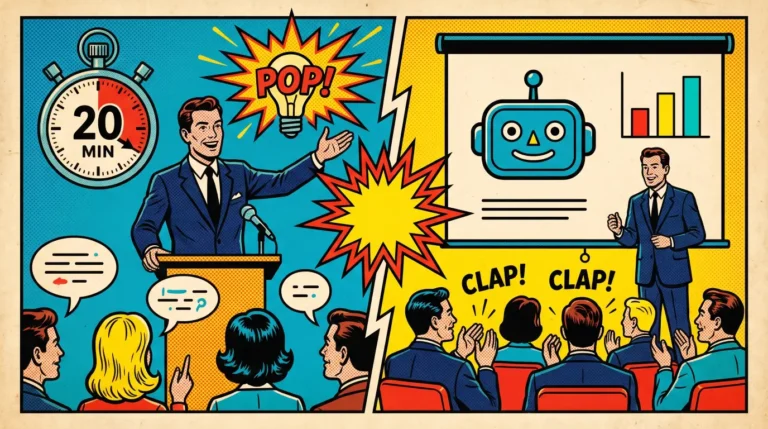
- The impulse talk (20 to 30 minutes): It opens, it provokes, it sets the theme. An AI impulse talk is the right choice when artificial intelligence is not the only topic of the day but the opener for discussions, workshops or a strategy meeting. It deliberately offers no depth – it creates attention and a shared starting point.
- The keynote (45 to 60 minutes): The main programme. This is where there is room for live demos, for the arc from technology to business value, and for the moment when skepticism tips over. If you want a shift in attitude in the room, you need that time.
- The workshop (half or full day): Where listening turns into doing. Sensible when participants should not only be convinced but enabled – with their own devices, their own data and their own use cases.
A combination often works best: an impulse talk in the morning as a door opener, a deep dive with a smaller group in the afternoon. Anyone who books 20 minutes and still expects live demos, industry examples and a Q&A will inevitably be disappointed. The format has to match the ambition.
I cover this decision in more detail in my article on the AI impulse talk: when a short impulse is enough and when you are better off booking a keynote.
How Does a Talk Win Over the Skeptics?
Every audience includes people who consider AI hype – or fear for their jobs. Both deserve respect rather than lecturing. That is why I work with one simple message: it is not AI that replaces you, but possibly a person who uses AI competently. And then I show the first small step everyone can take that same day. Change does not start with technology – it starts with a sense of achievement.
The order matters here. Open with the threat and you create resistance. Open with a benefit the individual listener can feel – less routine, fewer late evenings, fewer pointless trips – and you earn the attention needed for the harder questions later. Taking fears seriously does not mean avoiding them. It means raising them at the right moment.
How Do Event Planners Recognize a Good AI Speaker?
- First-hand practice: the speaker uses the tools daily instead of just reading about them.
- Industry fit: examples from the world of the audience, not from Silicon Valley.
- Interaction: questions, live experiments and demos instead of 90 minutes of one-way broadcasting.
- Actionability: every participant leaves the room with concrete next steps.
- Currency: with AI, a talk from two years ago is no longer a talk – it is a retrospective.
Which Mistakes Do Event Planners Make Most Often?
After many events, I keep seeing the same four patterns – and all four can be avoided beforehand:
- Choosing by fame alone. A prominent name fills the room, but prominence is no proof that someone understands your industry. Ask for examples from your own environment, not for TV appearances.
- No briefing call. Without a briefing you get the standard talk. Twenty minutes on the phone decide whether the examples land or stay generic.
- The wrong slot in the programme. A rousing AI talk right after lunch and just before the financial report fizzles out. If you want impact, give it a place.
- Technology clarified too late. Live demos need a stable internet connection and a clean image – not conference Wi-Fi that collapses at 10 a.m. That belongs in the briefing call, not in the 20 minutes before the start.
Planning an event? As a keynote speaker for artificial intelligence, digitalization and Microsoft 365, I bring technology topics to the stage in a way that sticks – hands-on, entertaining and immediately actionable. Book an AI keynote: content, formats, process and fee at a glance.
What Does a Talk on Artificial Intelligence Cost?
A talk on Artificial Intelligence is billed as a flat fee, regardless of audience size. My fee for an AI keynote is €6,900 plus VAT, plus a €500 travel fee. That includes the briefing call, tailoring the content to your industry, the 45 to 90 minute appearance with live demos, and a follow-up link list for your audience. Workshops and multi-day formats are quoted individually.
Three factors drive the price: the degree of customisation, the preparation time for up-to-date live demos, and travel. An off-the-shelf talk is cheaper – but it rarely stays with the audience. So ask less about the price and more about what actually happens during preparation: Who talks to your business units beforehand? Which examples come from your industry? All details on formats, process and fee are on the page book a talk on Artificial Intelligence.
Does an AI Keynote Work for an International Audience?
Yes – but only if the talk is built for that audience instead of merely being translated. I give the AI keynote in English and German: live on stage, online from the video studio or hybrid. English-language settings so far have included an international management meeting at Lufthansa Cargo and a congress keynote. Three things decide whether a talk lands with an international audience.
The examples. A case from a German mid-sized company says little to a Scandinavian or Dutch audience. Before the event we agree which industries, company sizes and roles are in the room, and the demos are picked accordingly.
The tools. Availability, data protection rules and licence models differ from market to market. A live demo of a tool that the audience is not allowed to use at work creates frustration, not appetite – so the tool selection follows the audience, not my habits.
The pace. With many non-native speakers in the room, clear speech, few idioms and visible anchors on screen matter more than speed. The rule of thumb: one thought per slide, one result per demo.
If you are planning an English-language event, the AI keynote overview lists formats, lead times and what is included.
Frequently Asked Questions (FAQ)
How long should a good AI keynote be?
45 to 60 minutes with live demos has proven ideal, preferably followed by a Q&A. For workshops and deep dives, half or full days make sense – depending on whether inspiration or implementation is the priority.
What is the difference between an impulse talk and a keynote?
The difference is not only length but purpose. An impulse talk runs 20 to 30 minutes and is meant to set the theme – an opener for whatever follows. A keynote takes 45 to 60 minutes and aims to change the attitude in the room, with live demos and examples from your industry. In short: the impulse talk opens the door, the keynote walks you through it.
Does the audience need prior knowledge?
No. A good AI keynote picks up everyone – from the board member to the apprentice. The examples are chosen so beginners can follow while advanced users still take away something new.
What technology does an AI keynote with live demos need?
Above all a reliable internet connection – ideally wired or via a dedicated mobile connection, not the guest Wi-Fi. Beyond that, a projector or LED wall with enough resolution so that what happens on screen stays readable in the back row. Everything else we clarify in the briefing call.
How current is the content given the pace of AI development?
Serious AI speakers update their talks continuously – in my case, new tools and developments often flow into the live demos within the same week. Feel free to ask in the briefing call when the talk was last revised.
How does an AI talk differ from AI training?
An AI talk runs 45 to 90 minutes, addresses a large audience and has one clear goal: to give orientation and spark the appetite to get started. Training runs from half a day to several days, works in small groups and practises concrete steps on the participants' own devices. In practice the combination works best: the impulse talk opens the doors, the training delivers the implementation.
Do you deliver AI keynotes in English?
Yes. The keynote is available in English and German – live on stage, online from the professional video studio or hybrid. For an international audience we agree in the briefing call which examples carry in that market; otherwise you translate the words but not the effect.
What changes when the audience is international?
The structure stays the same, the material changes: industry examples from the markets represented in the room, tools the audience is actually allowed to use, and a slower pace with fewer idioms. Everything else – live demos instead of slide battles, concrete next steps at the end – works the same in every language.