Key Takeaways
- AI agents complete multi-step tasks independently – from research assignments to process chains.
- The difference from a chatbot: agents plan, use tools and work while you do other things.
- For SMEs what counts is not the hype but the question: which process is worth starting with?
- Rule of thumb for the start: frequent, rule-based, time-consuming – and a human checks the result.
- Power Virtual Agents is now part of Microsoft Copilot Studio – the low-code entry point for building your own AI agents in a Microsoft 365 environment.
After the chatbot year comes the agent era – or so it sounds from every direction. In my keynotes I usually hear two reactions: fascination and the quiet question “What does that mean for us, concretely?”. Exactly this question deserves an honest answer.
What Distinguishes an AI Agent from a Chatbot?
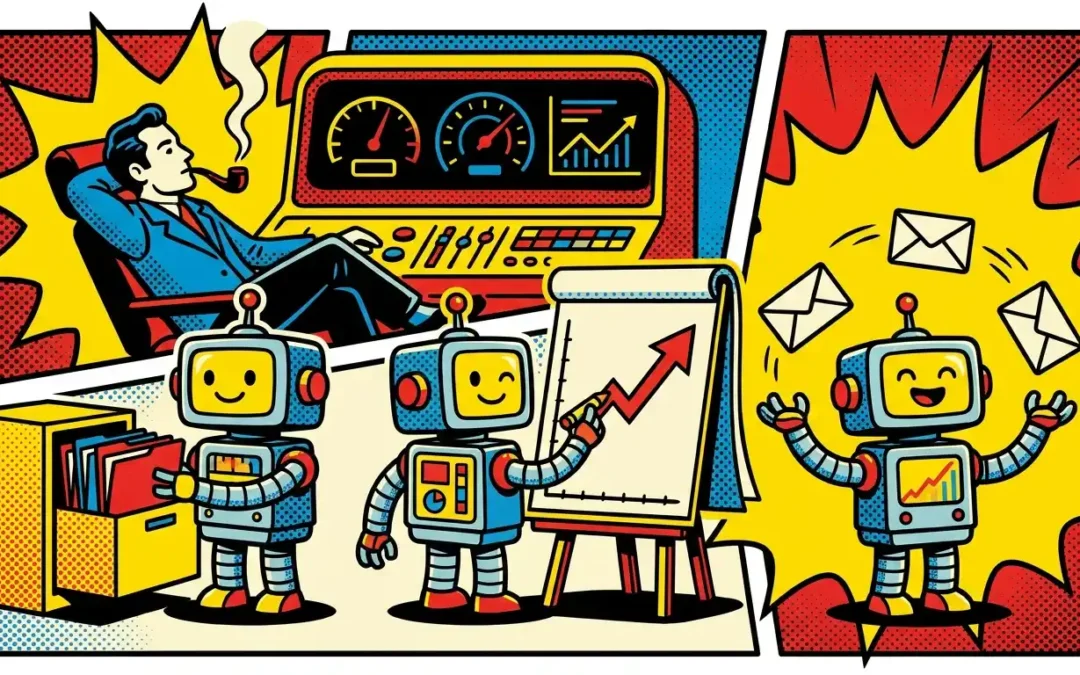
A chatbot answers, an agent works: it breaks an assignment into steps, uses programs and data sources, checks interim results and reports back with the finished outcome. “Write me a summary” becomes “Monitor these five sources and file a briefing for me every morning”. This is no longer future music – but it needs smart guardrails.
Which Use Cases Pay Off First in SMEs?
- Recurring research: market, competitor or supplier monitoring.
- Document pipelines: turning inquiries, minutes or receipts into structured data and follow-up actions.
- Internal assistance: meeting preparation, summaries, follow-ups.
- Quality assurance: having texts, quotes and data checked against defined rules.
Where Is Caution Required?
Wherever mistakes are expensive or data is sensitive. Agents need defined boundaries: what may they do alone, where is a human sign-off mandatory? My recommendation from practice: start small, check results, build trust step by step – like a new employee in probation. And: understand processes first, then automate. A chaotic process only gets faster chaos through an agent.
How Do You Start with a First AI Agent?
The best entry point is a task that a human today does frequently and reluctantly. Five steps are enough for the first attempt:
- Pick the process: frequent, rule-based, time-consuming – and without existential risk if it goes wrong.
- Write down the workflow the way you would explain it to a new colleague.
- Define the tools: which sources and systems may the agent access?
- Run two weeks in shadow mode – the human still decides, the agent only proposes.
- Compare the results and only then hand over responsibility step by step.
This route costs little and delivers something no study can replace: your own experience, in your own company, on a real task.
What Happened to Power Virtual Agents – and What Can Copilot Studio Do for SMEs?
Anyone who wanted to build a chatbot in the Microsoft world a few years ago ended up with Power Virtual Agents. The tool no longer exists under that name: it is now part of Microsoft Copilot Studio. The kit for question-and-answer bots has become a low-code environment for AI agents – and existing classic bots can be carried over and converted into agents there.
For SMEs this matters mainly because many companies already work with Microsoft 365. Copilot Studio connects an agent to sources such as SharePoint or Outlook through prebuilt connectors and publishes it where people already work – for example in Microsoft Teams or on your own website. Three starting scenarios suggest themselves:
- Internal knowledge agent: It answers questions about policies, product data or procedures based on approved documents.
- Service chatbot on the website: It handles standard inquiries and hands complex cases over to a human.
- Process agent: It triggers follow-up steps after an inquiry, for example via Power Automate, and brings in a human for approval at defined points.
Because agents in Copilot Studio are largely built from instructions in natural language, the same skill counts as in everyday work with Copilot: describing clearly what you want. I show how that works in my article on briefing Microsoft Copilot properly. From practice: the tool is rarely the bottleneck. Low-code does not mean low governance – an agent built in Copilot Studio also needs an owner in the business unit and the guardrails from the next section.
Which Guardrails Does an Agent Need in a Company?
An agent without limits is not progress but risk. Four guardrails have proven themselves: clear data classes, meaning which information may enter the system at all. Defined approval points where a human confirms. Logging, so it stays traceable what happened on which basis. And an off switch with a named person allowed to press it.
The question of ownership matters: an agent needs an owner in the business unit, not only in IT. Whoever is accountable for the results must also decide on the limits.
What Does This Mean for IT and Data Protection?
Three points are best clarified up front. First, since February 2025 the EU AI Act requires sufficient AI literacy among staff – training is therefore not optional. Second, personal data belongs only in services with a proper data processing agreement. Third, you should define which content never goes into external systems at all, for example draft contracts or HR matters. Those three sentences on your intranet save many case-by-case debates later.
Planning an event? As a keynote speaker for artificial intelligence, digitalization and Microsoft 365, I bring technology topics to the stage in a way that sticks – hands-on, entertaining and immediately actionable. Book an AI keynote: content, formats and fee at a glance.
Frequently Asked Questions (FAQ)
Do AI agents need their own IT infrastructure?
Not to start with – many tools run in existing environments such as Microsoft 365 or as cloud services. More important than infrastructure are clear processes and responsibilities.
How much time does an agent realistically save?
With well-chosen use cases, several hours per week and employee are realistic – the key is that the process occurs often enough to justify the setup effort.
Is the topic ready for an annual convention?
Yes – especially now: the technology is ready, orientation is missing. A keynote that separates hype from substance and shows concrete starting points hits the nerve of decision-makers.
Do AI agents replace jobs?
In practice they first shift tasks: routine moves to the agent, review and decision stay with the human. Addressing that shift openly takes away more fear than any reassuring slogan.
How do we detect whether an agent produces nonsense?
With samples whose answer you already know: let it handle ten cases where you know the correct result. What shows up there reveals the limits more reliably than any data sheet.
What happened to Power Virtual Agents?
Power Virtual Agents has been folded into Microsoft Copilot Studio. Classic chatbots built with Power Virtual Agents can still be managed there and converted into agents with the current AI features. Anyone planning a new chatbot or agent in a Microsoft environment today therefore starts directly in Copilot Studio.