Key Takeaways
- Whether AI makes us dumber or smarter is decided by how we use it – not by the technology.
- A 2025 MIT study shows: those who outsource thinking completely are measurably less mentally engaged.
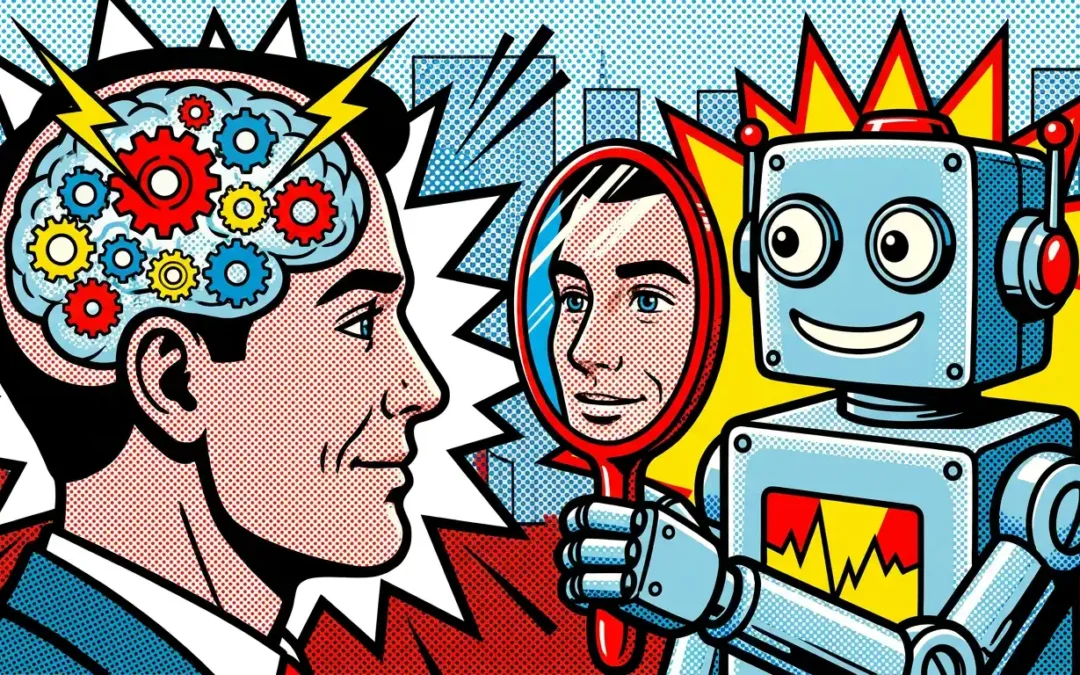
- Used as a sparring partner, AI sharpens thinking – used as an autopilot, it dulls it.
- For companies this is a culture question: do you demand output or judgment?
“Are we getting dumber with AI?” – hardly any audience question comes up more often in my keynotes. My answer: the question is justified but wrongly framed. The calculator weakened mental arithmetic and accelerated mathematics. What matters is what we delegate – and what we train.
What Does the Research Say?
In 2025, the MIT Media Lab measured in the study “Your Brain on ChatGPT” what happens when people have texts written entirely by AI: lower brain engagement, poorer recall of their own text, less identification with the result. The finding is no surprise – unused muscles grow weak. But it is not a verdict on AI; it is a verdict on one particular way of using it.
How Do You Use AI So That It Makes You Smarter?
- Think first, then challenge the AI: “What am I missing? Argue against me.”
- Use AI as a critic, not just a producer – request counter-positions instead of confirmation.
- Always verify and refine results: the last thinking step stays with the human.
- Deliberately train your thinking muscles: keep practicing core competencies, delegate routine.
What Does This Mean for Your Company Culture?
Teams adopt the usage culture of their leadership. Where only output counts, AI becomes a shortcut machine – including the risks of unchecked results. Where judgment remains in demand, it becomes a training partner. This is exactly the fork in the road I make tangible in keynotes: with exercises showing how the same AI becomes a thinking amplifier or a thinking substitute.
How Do You Spot Cognitive Convenience in Your Team?
The creeping effect shows up long before any study – in everyday work. Four warning signs come up again and again with clients:
- Results are adopted unchecked because they sound well written.
- Asking for the source is met with a shrug.
- Texts from different departments suddenly sound identical.
- There is less debate in meetings – not out of agreement, but out of convenience.
None of these signs is a reason to ban AI. They are a reason to talk about how it is used. The tool is neutral; the habit decides.
Which Rules Encourage Thinking Instead of Copying?
Five rules have proven themselves in companies that use AI seriously and still stay capable of thought:
- Your own thought first, then the machine – even if it is only three bullet points.
- Use AI as opposition: have your draft attacked rather than applauded.
- Ask for sources and check at least one of them yourself.
- Mark where AI contributed – that creates honesty instead of suspicion.
- Accountability for the result always stays with a human being who has a name.
How Do You Anchor This in Leadership Practice?
Culture grows from example, not from policy documents. Leaders who openly show how they work with AI themselves – including the cases where the output was useless – create more willingness to learn than any works agreement. Two things help additionally: protected learning time, for instance one hour a week, and a short exchange format in which teams share their best and their worst experiences. Anyone who only shows successes trains their people to stay silent.
Planning an event? As a keynote speaker for artificial intelligence, digitalization and Microsoft 365, I bring technology topics to the stage in a way that sticks – hands-on, entertaining and immediately actionable. Book an AI keynote: content, formats and fee at a glance.
Frequently Asked Questions (FAQ)
Should career starters avoid AI at first?
No – but they should build fundamentals in parallel. Those who never learned to structure a text themselves cannot judge AI drafts. Learning and delegating belong together.
Is this topic suitable for an evening event?
Excellently – it combines science, practice and a pinch of provocation. Ideal for formats meant to spark reflection and discussion, from fireside chats to association evenings.
Is there a simple rule for healthy AI use?
My rule of thumb: AI may be the second opinion, never the only one. Those who start every task with an own thought and end it with an own judgment stay mentally fit – and get faster.
Do employees unlearn skills because of AI?
That depends on usage. Whoever uses AI as a shortcut around thinking loses practice. Whoever uses it as a sparring partner gains speed and quality. That difference is exactly what you should name in your company.
Should we make the use of AI mandatory?
Obligation creates resistance. What works better is the combination of an available tool, training and the clear expectation that results get better or faster – the path there stays with the team.