
Key Takeaways
- Digital leadership does not mean more tools but different habits: clarity, transparency, trust.
- Hybrid teams need explicit rules – what the hallway used to settle must now be agreed.
- Role modeling beats rulebooks: teams adopt their leader's digital discipline – for better or worse.
- For leadership summits the topic is ideal: relevant for everyone in the room, immediately actionable.
The most frequent question at leadership conventions is not “Which tool?” but “How do I lead people I no longer see every day?”. The answer has less to do with software than many hope – and more to do with craft than many believe.
What Does Digitalization Really Change About Leadership?
It removes leadership's most convenient crutch: presence. Those who measured performance by visibility in the office stand without a compass in the hybrid everyday. Digital leadership replaces control with clarity – clear goals, clear agreements, clear availability rules. That is more demanding than presence checks. And more effective.
Which Digital Habits Distinguish Good Leadership?
- Async first: not every question is a meeting – good leadership writes traceably.
- One source of truth: tasks, decisions and knowledge visible to all in one place.
- Availability with boundaries: those who email at night lead at night – role modeling includes breaks.
- Nurture rituals: fixed check-ins and real attention replace door-and-hinge conversations.
How Does This Topic Reach Your Leadership Summit?
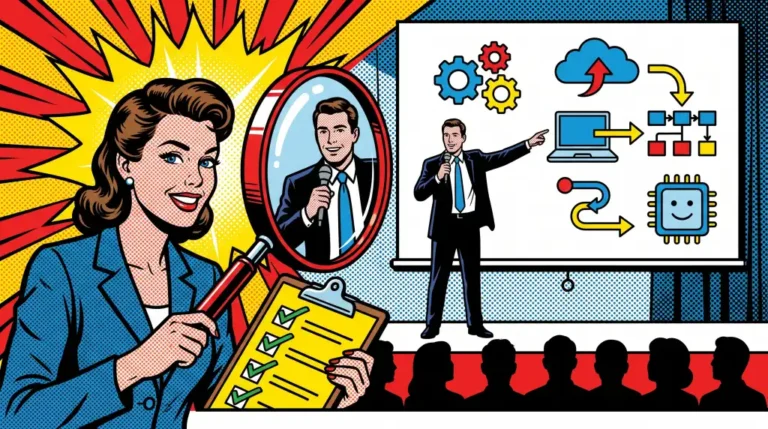
Most effectively as an interactive impulse: I work with the participants' real situations – from the overflowing inbox to the silent hybrid meeting – and show live how digital tools make leadership easier instead of more complicated. The goal: leaders who do three things differently on Monday morning.
Which Leadership Mistakes Do Digital Tools Create?
Digital tools amplify existing leadership – for better and for worse. Four patterns show up in almost every company: constant availability sold as commitment. Tool sprawl, where the same information sits in four channels. Meeting inflation, because a video call is scheduled faster than a hallway conversation. And control instead of trust, when activity indicators become performance reviews.
The remedy is rarely technical. It is agreement: which channel for which purpose? By when is an answer expected – and by when explicitly not? Who decides alone, who decides as a team? Leaders who answer these three questions in writing for their area gain calm in the system immediately.
How Do You Measure Whether Digital Leadership Works?
What is not measured stays a declaration of intent. A few honest metrics are enough – captured before the summit and 90 days after:
- Meeting hours per week and leader – the goal is fewer, not more.
- Response expectations: how many messages arrive after 6 p.m., how many are answered instantly?
- Duplicate storage: in how many systems does the same document live?
- One single survey item: do my people know what is expected of them?
My recommendation: pick three of these metrics, note the starting value on the day of your leadership summit and review it one quarter later. That loop turns a good impulse into measurable change.
Which Digital Tools Does Leadership Really Need?
The answer is unspectacular: surprisingly few, but used consistently. Five building blocks cover almost every leadership task:
- One place for tasks and responsibilities – not three parallel lists.
- One channel for short alignments, so the mailbox is free again for binding matters.
- One shared storage with a clear structure instead of personal drives.
- A maintained calendar that also contains thinking time, not only meetings with others.
- A note system that records decisions – the most expensive rework comes from forgotten resolutions.
Notably, none of these is new or expensive. The difference between digitally overwhelmed and digitally confident almost never lies in the tool list but in the discipline of agreeing on a few.
Planning an event? As a keynote speaker for artificial intelligence, digitalization and Microsoft 365, I bring technology topics to the stage in a way that sticks – hands-on, entertaining and immediately actionable. Book a digital transformation keynote: content, formats and fee at a glance.
Frequently Asked Questions (FAQ)
Is this a technology or a leadership topic?
Both – and that is exactly the point: technology without leadership principles creates digital noise, leadership principles without tech competence remain theory. The keynote connects both worlds.
Is the topic also suitable for experienced leaders?
Especially for them: the longer the leadership experience, the deeper the habits from the presence world. The impulse translates proven leadership strength into the digital everyday.
What distinguishes the keynote from a leadership seminar?
Pace and effect: the keynote sets the impulses and the shared language in 60 minutes; seminars deepen afterwards. Many clients combine both.
How long is a keynote at a leadership summit?
Typically 45 to 60 minutes plus questions. For leadership retreats I like to combine the keynote with a 90-minute working session in which your leaders formulate their own ground rules.
Can we bring in our own topics and examples?
Yes, and it is explicitly welcome. Four weeks before the date we go through your situation, often supported by a short survey among your leaders. The keynote then works with your examples instead of generic ones.